
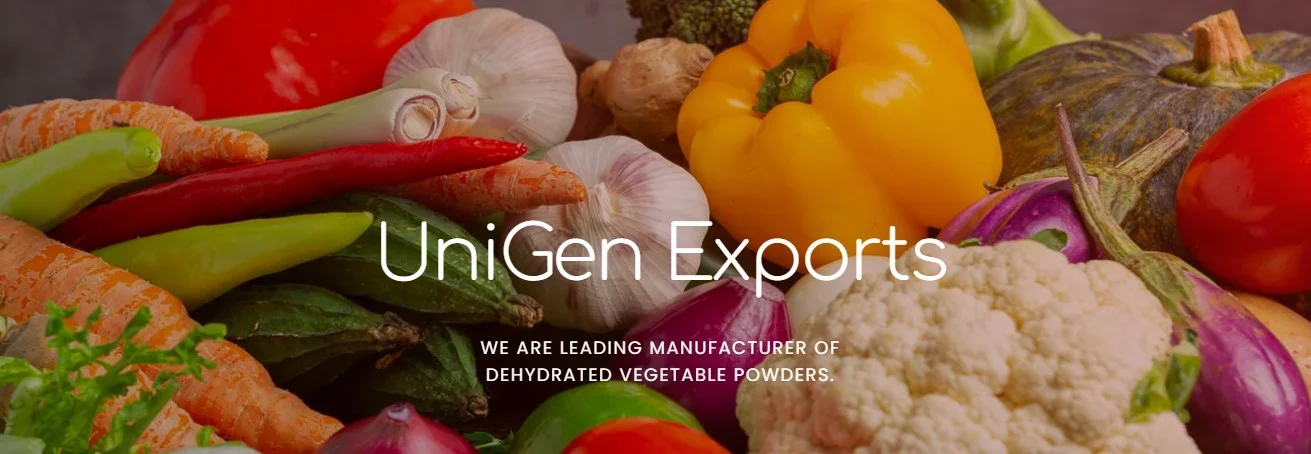
The Ready-to-Eat (RTE) and Ready-to-Cook (RTC) industries are undergoing a massive transformation, moving away from heavy preservatives toward “clean-label” ingredients. At the center of this shift is Spray-Drying Technology—a process that turns liquid vegetable concentrates into fine, stable, and highly potent powders.
In the Indian export market, leaders like UniGen Exports, Natural Dehydrated Vegetables, and Mahadev Foods are pioneering the use of these powders to meet the global demand for convenience without compromising on nutrition.
1. What is Spray-Drying?
Unlike traditional air-drying, which can be slow and inconsistent, spray-drying involves atomizing a liquid vegetable puree into a hot drying medium. This almost instantaneous transition from liquid to powder preserves the vegetable’s essential characteristics.
A free-flowing powder with low moisture content ($<5\%$) that dissolves instantly in water or oil, providing immediate flavor release.
2. Key Advantages for the RTE Industry
A. Instant Solubility & Texture
For products like instant soups, dal mixes, or pasta sauces, consistency is everything. Spray-dried powders offer instant solubility. Unlike traditional flakes, which require rehydration time, these powders integrate seamlessly, ensuring a smooth mouthfeel in every serving.
B. Nutritional Integrity & Color
Traditional high-heat drying can “burn” natural pigments and vitamins. Spray-drying occurs so rapidly that thermal damage is minimized. This allows brands to offer vibrant green chili or bright carrot powders that maintain their antioxidant profiles and natural “fresh” look without artificial dyes.
C. Natural Preservation
By removing nearly all water molecules, spray-drying creates a product naturally resistant to microbial growth. This allows RTE manufacturers to claim “No Added Preservatives”—a major selling point for health-conscious consumers.
D. Global Logistics Efficiency
Vegetables are largely water. Converting $100$ kg of fresh produce into roughly $5$ to $8$ kg of concentrated powder significantly reduces shipping costs and carbon footprints for global exporters.
3. The Role of Indian Industry Leaders
The market is currently supported by specialized manufacturers who cater to different segments of the RTE supply chain:
| Feature | Key Providers | Impact on RTE |
|---|---|---|
| High-Purity Bulk Supply | UniGen Exports | Acts as a premier Bulk Dehydrated Vegetable Powder Supplier, providing standardized powders (Onion, Garlic, Beetroot) for large-scale food seasoning and fortification. |
| Industrial Processing | Natural Dehydrated Vegetables | Supplies the heavy-duty base for bulk spice blends and instant noodle seasonings. |
| Specialized Fruit & Veg | Mahadev Foods | Provides the “tang” and “sweetness” in snacks via mango and strawberry powders. |
| Technical Additives | Vinayak Ingredients | Focuses on the science of plant-based bioactive compounds for functional foods. |
4. The Future: Clean Labels and Fortification
The next frontier for spray-dried powders is functional fortification. Manufacturers are now looking to partners like UniGen Exports and Vinayak Ingredients to provide powders enriched with bioactive compounds.
We are seeing a rise in:
-
Fortified Instant Meals: Using spray-dried spinach and carrot for natural Vitamin A and Iron.
-
Clean-Label Umami: Replacing MSG with the natural savory notes found in concentrated mushroom and tomato powders.
Spray-dried vegetable powders have solved the greatest challenge of the modern food industry: The freshness-convenience paradox. By capturing the essence of fresh Indian produce in a shelf-stable format, exporters are ensuring that “instant” food no longer means “unhealthy” food.